
A quick look at the forces that threaten homes long before flames ever arrive.
Most structures lost in wildfires never make contact with the main fire front.
Homes are destroyed by spot fires.
Small, fast-moving ignition points caused by wind-driven embers landing on roofs, decks and dry vegetation.
These embers can travel long distances ahead of a fire, quietly igniting dry fuels around a property.
By the time the flames reach a neighbourhood, dozens of small fires may already be burning.

Across North America, embers are recognized as the leading cause of home loss during wildfire events.
Spot fires are small ignition points that start when wind-driven embers land on dry fuels around a home.
They can ignite roofs, gutters, decks, garden beds, fences, exterior walls or dry vegetation long before the main wildfire even arrives.
These fires grow quietly and out of sight, under decks, behind sheds, inside bark mulch or in accumulated debris.
By the time flames become visible, a full structural fire may already be underway.
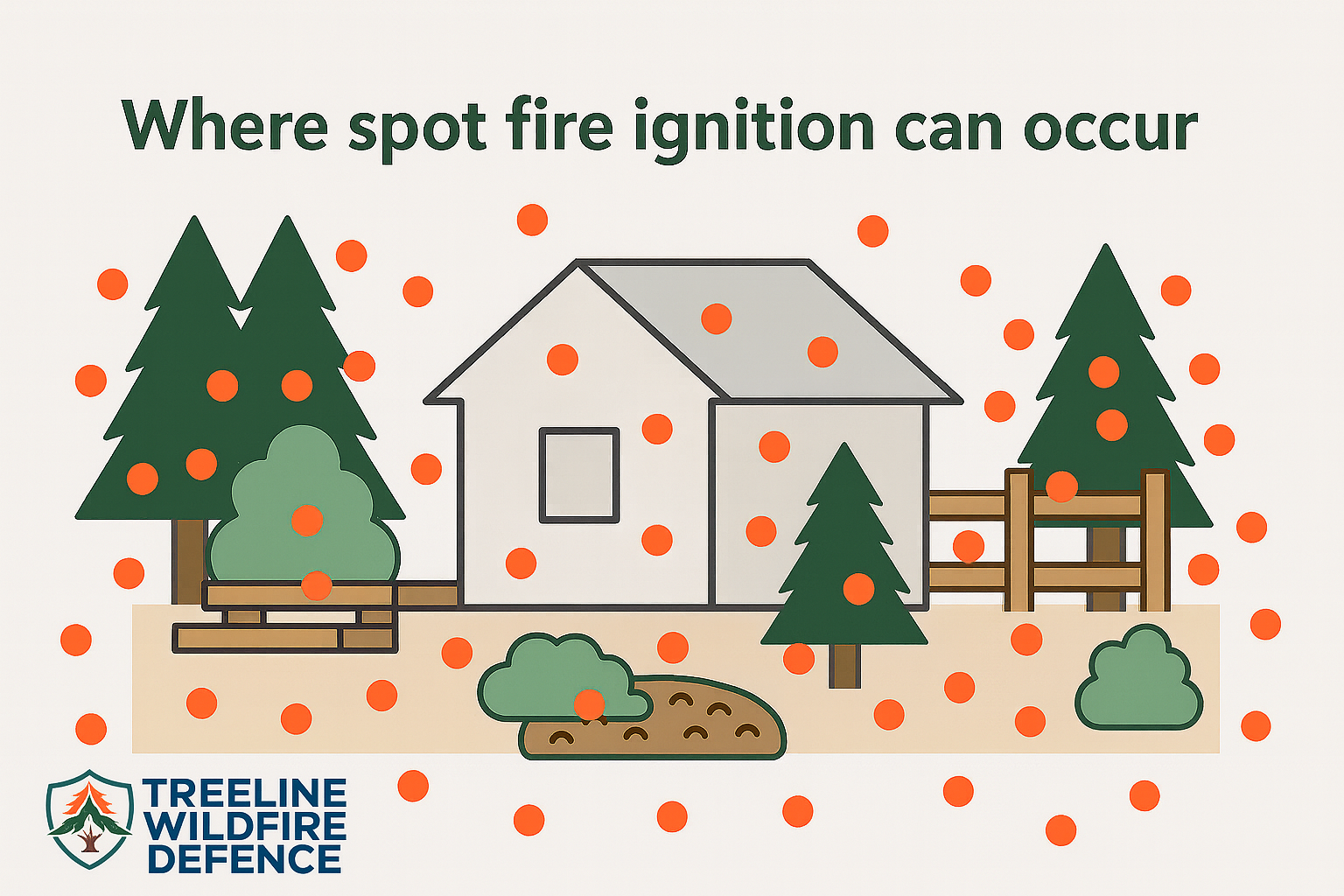
During extreme fire weather, wind can carry thousands of burning embers far ahead of the main flames.
These embers move through the air like a blizzard. Except every glowing ember has the potential to start a new fire.
Wildfires can generate their own wind.
As hot air rises, surrounding air is pulled in to replace it. This creates strong, erratic gusts that lift embers high into the air and push them across landscapes, rooftops, and neighbourhoods.
The result
a fast-moving storm of ignition points that can overwhelm communities long before the fire front arrives.
For most homeowners, the real wildfire threat isn’t a wall of flames, it’s thousands of embers landing on vulnerable parts of a property. A single ember can smoulder unnoticed for hours before igniting a deck board, garden bed, woodpile or fence line.
When this happens on multiple homes at once, neighbourhood fire crews can be overwhelmed. Spot fires spread quickly and without early protection in place, a small ember can become a full structural fire in minutes.
The good news is that spot fires are preventable. With the right combination of defensive landscaping, smart irrigation and engineered suppression, the risk of ignition drops dramatically.
Removes the fuels embers rely on, reducing ignition points around the home.
Keeps vegetation healthy, hydrated and far less likely to ignite.
Wet key ignition zones and structure surfaces during high-risk conditions.
Embers don’t need flames to start a fire. They only need a place to land.
These are the areas around most homes where ignition starts quietly.
Often unnoticed until it’s too late.
Dry leaves and needles catch embers instantly.

Small gaps allow embers to smoulder under materials.

Wood surfaces ignite from a single persistent ember.

Dry mulch smoulders deep and spreads into structures.
Wood fences can channel fire directly to the home.

Unmaintained stored firewood ignites quickly and burns intensely

Combustibles inside make ignition fast and severe.
Openings allow embers to enter attic and roof spaces.
TreeLine Wild Fire Defence focuses on reducing ignition risks long before flames arrive, defending the areas where embers are most likely to land and start spot fires.
Our three-layer defence strategy strengthens your property’s resilience by combining strategic landscaping, controlled moisture levels and engineered suppression during high-risk conditions.
TreeLine Wild Fire Defence removes or modifies the dry fuels that embers depend on.
This includes clearing gutters, trimming branches, spacing vegetation, removing debris and treating high-risk areas around the home.
These improvements reduce the number of places where spot fires can quietly begin.
Healthy, well-hydrated vegetation is far less likely to ignite. TreeLine Wild Fire Defence designs irrigation systems that use automated timers, seasonal scheduling and optional moisture sensors to maintain consistent hydration during dry periods.
These climate-responsive controls scale easily from small garden zones to full-property irrigation, helping reduce ignition risk throughout the season.
TreeLine Wild Fire Defence provides custom, automated systems that deliver targeted surface hydration to the most vulnerable areas of a home.
Using high-flow pumps and climate-responsive activation, these systems wet roof edges, eaves, decks, siding, fence lines, and surrounding ignition zones during high-risk conditions.
By keeping these surfaces hydrated when embers are most likely to land, the risk of property level spot-fire ignition is significantly reduced.
When defensible landscaping, moisture management and suppression systems from TreeLine Wild Fire Defence work together as a single defence strategy, ember ignition risk is significantly reduced across the entire property.
Understanding how wildfires spread is the first step.
The next step is identifying the specific ignition points on your property and determining which layers of defence will offer the most protection for your home.
TreeLine Wild Fire Defence offers a complete suite of wildfire-defence services designed for homes, acreages, strata properties and small businesses across high-risk regions of British Columbia.
Whether you’re looking to reduce ignition risks, improve moisture levels or install automated surface-hydration systems, our specialist services are tailored to your property’s unique environment.
Specialist wildfire-defence expertise
FireSmart-aligned assessments and planning
Automated and climate-responsive solutions
Professionally installed surface-hydration systems
Tailored irrigation and moisture strategies
Ongoing maintenance and seasonal support
A complete, multi-layer defence approach
TreeLine Wild Fire Defence offers specialist on-site assessments to identify ignition risks, review property vulnerabilities, and provide tailored strategies across landscaping, irrigation, and suppression. This is the best starting point for any property seeking improved wildfire resilience.
Most properties benefit from improvements in more than one area, whether it’s fuel reduction, moisture management, or surface hydration.
A combined approach provides the strongest defence against ember ignition.
Choose the closest option.
You can adjust details in the next step.
Get a Spring Action Plan in 48 hours.
What is included
Interested in irrigation upgrades or future wildfire suppression options? Submit your details below and I’ll follow up directly to discuss your property.
Get a Spring Action Plan in 48 hours.
What is included
From $175 (GST included)
Request a Property Assessment
This form takes about 2 minutes.
Your registration has been received. You’ll be among the first to be notified when TreeLine Wild Fire Defence opens scheduling for property assessments in early 2026.
We’ll be in touch as soon as booking becomes available
Thank you for contacting TreeLine Wild Fire Defence.
Your message has been received and we will respond shortly using your preferred contact method.